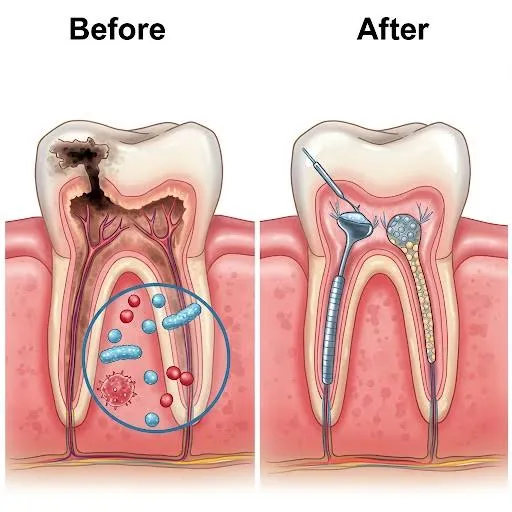
 Illustration
Tooth pain right now? What to do today
We offer same-day appointments for tooth pain. Message us on WhatsApp or call 0320 830 3535 with where it hurts and for how long. Until you arrive:
- Take an over-the-counter painkiller exactly as directed on the pack.
- Do not put a painkiller tablet on the gum or tooth. It burns the gum and does not help the pain.
- Rinse with warm salt water and use a cold pack on the outside of the cheek, 15 minutes at a time.
- Avoid chewing on that side, and avoid very hot, cold or sweet food and drinks.
- Keep your head raised when lying down, which can ease throbbing at night.
Go to a hospital emergency department straight away if swelling is spreading to your eye or neck, you have a fever, or you find it hard to swallow or breathe. These can be signs of a serious infection.
When do you need a root canal?
Inside every tooth is soft tissue called the pulp, which holds the nerve and blood supply. Deep decay, a crack, a large old filling or an injury can let bacteria reach the pulp. Once it is infected or badly inflamed, it cannot heal on its own.
- Strong or lingering pain, especially when biting or at night
- Sensitivity to hot or cold that stays after the hot or cold is gone
- Swelling of the gum or face near a tooth, or a small pimple on the gum
- A tooth that has darkened after decay or an injury
Some infected teeth cause no pain at all and are only found on an X-ray. A check-up and X-ray tell us whether a root canal is needed, or whether a simpler filling is enough.
How root canal treatment is done
- Assessment: we examine the tooth and take an X-ray to see the roots and the infection.
- Numbing: the tooth is fully numbed, so most patients feel pressure rather than pain.
- Cleaning: the infected pulp is removed and the root canals are cleaned, shaped and disinfected.
- Sealing: the canals are filled and sealed so bacteria cannot get back in.
- Restoring: the tooth is rebuilt with a filling, and back teeth usually need a crown to protect them from cracking.
Depending on the tooth and the infection, treatment is done in one or more visits. We tell you how many before we start.
Why save the tooth instead of pulling it?
Keeping your natural tooth keeps your bite balanced and stops the teeth next to it from drifting into the gap. A removed tooth usually needs replacing with an implant or bridge, which takes more time and costs more. When a tooth can be saved with a root canal, that is usually the better option.
Sometimes a tooth is too broken or the infection too severe to save. If that is the case, we will tell you honestly and explain the options, including extraction and replacement.
After your root canal
The tooth may feel tender for a few days, which simple pain relief usually helps. Avoid chewing hard food on it until the final filling or crown is in place. After that, look after it like any other tooth: brush twice a day, clean between your teeth and keep up regular check-ups.