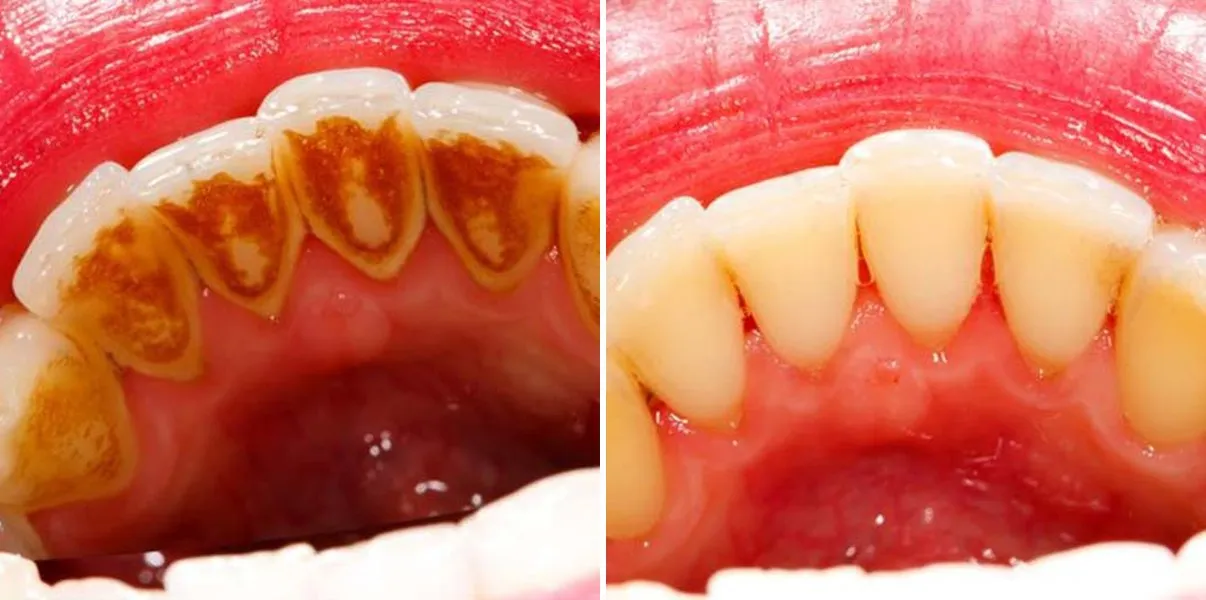
 BeforeAfter
Why scaling matters, even if your teeth look clean
Tartar (also called calculus) often forms along and just below the gum line, where it is hard to see in the mirror. It is rough, so it collects more plaque, and the bacteria in that plaque irritate the gums. Early signs include gums that bleed when you brush, bad breath that keeps coming back, and gums that look red or puffy.
Left alone, this irritation can progress from gingivitis to periodontitis, where the support around the teeth slowly breaks down. Regular scaling is one of the simplest ways to prevent that.
What happens during your visit
A scaling and polishing appointment is usually straightforward and does not need any recovery time.
- Check-up: we look at your teeth and gums and explain what we see before starting.
- Scaling: an ultrasonic scaler and fine hand instruments lift tartar from the tooth surface and along the gum line.
- Polishing: a polishing paste smooths the surface and removes surface stains from tea, coffee and tobacco, so plaque is slower to stick.
- Advice: we show you the areas that need extra attention at home and suggest when to come back.
Will it hurt?
Most patients feel vibration and some coolness from the water spray rather than pain. If your gums are already inflamed or you have sensitive teeth, you may feel some sensitivity, and we can go slowly or numb the area if needed. Mild gum tenderness for a day or two afterwards is normal and settles on its own.
How often should you have it done?
For many people, a clean every six months works well. Some patients build tartar faster, for example smokers, people with braces or those with a history of gum problems, and may benefit from more frequent visits. We will recommend an interval based on what we find, not a fixed sales schedule.
Scaling also gives us a chance to spot early cavities, worn fillings or other problems while they are still small and simple to fix.